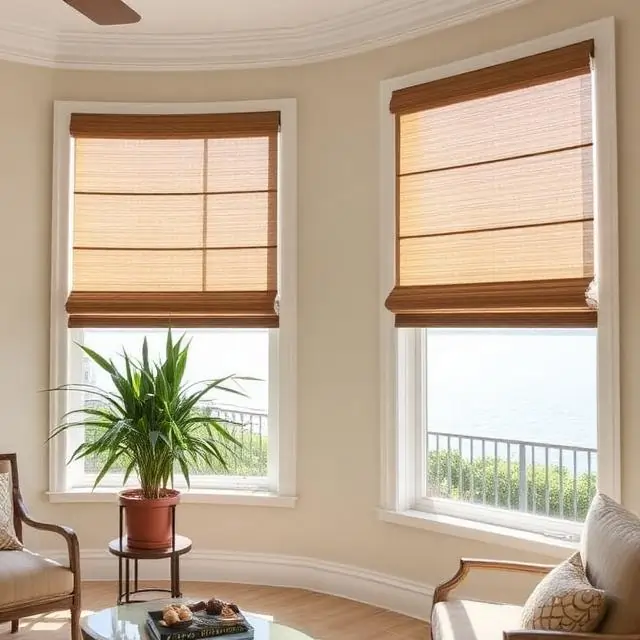
West-facing windows in Tampa aren’t just a comfort problem — they’re a heat problem, a fading problem, a sky-high-electricity-bill problem. Between 2 PM and sunset, the afternoon sun hits west- and southwest-facing glass at low, direct angles, driving heat into your living room, bedroom, or kitchen with almost nothing to stop it. That’s not a Florida exaggeration. The Tampa Bay area averages over 244 sunny days per year, and in summer, west-facing rooms can feel 10 to 15 degrees hotter than the rest of the house — even with the AC running full blast.
The fix isn’t heavier curtains or blackout panels you have to manually wrestle with every afternoon. The fix is motorized shades — specifically chosen fabrics that manage solar heat at the glass level, scheduled to drop automatically right when the sun hits. At Hive, we’ve designed and installed motorized shading systems throughout Tampa Bay, and west-facing windows are the single most common reason homeowners call us. This guide breaks down the science, the solutions, and the exact fabric choices that perform best in Florida’s climate.
Why West-Facing Windows Are Tampa’s Biggest Sun Problem
Not all windows are created equal when it comes to heat gain — and in Tampa, west-facing windows are in a category of their own. Here’s why: the sun rises in the east, peaks high at midday, and descends toward the west. By the time it’s hitting your west-facing glass in the late afternoon, it’s no longer overhead. It’s low in the sky, shining almost directly through the window at a flat angle — and that’s when solar heat transfer is at its maximum.
East-facing windows catch the morning sun, which is milder and lower in intensity. North-facing windows rarely see direct sun at all. But west- and southwest-facing windows absorb the hottest, most intense radiation of the day, right when your home has already spent 8 hours warming up.
- Peak heat hours: West-facing glass in Tampa sees maximum solar intensity from 1:30 PM to 7:00 PM in summer
- Room temperature impact: Unshaded west-facing windows can raise room temperature 10–15°F above the ambient indoor temperature
- Solar heat gain coefficient (SHGC): The measure of heat passing through glass is worst during low-angle afternoon sun
- UV damage: West-facing Florida rooms see accelerated fading on floors, furniture, and artwork
- HVAC strain: Energy demand spikes in the afternoon precisely when grid rates are highest — compounding your bill
The result is a home that fights itself every afternoon: your AC working overtime to counter what your unshaded windows are letting in. Motorized shades with the right fabric don’t just make the room more comfortable — they stop the heat before it ever enters. That’s a fundamentally different approach than trying to cool a room after it’s already heated.
According to the U.S. Department of Energy, heat gain and heat loss through windows are responsible for 25–30% of residential heating and cooling energy use. Addressing west-facing windows directly is one of the fastest-payback improvements a Tampa homeowner can make.
How Motorized Shades Combat Heat Gain at the Source
The critical distinction most homeowners miss: the best place to stop solar heat is at the glass, not inside the room. Heavy drapes and blackout curtains trap heat between the fabric and the window — they still let heat into the room, they just hold it near the glass longer. The result is a hot pocket of air that eventually convects into your living space.
Exterior shading is most efficient, but it’s not always practical or aesthetically desirable. The next best option — and the one that works in virtually every Tampa home without structural changes — is a solar shade fabric positioned close to the glass. When a solar shade is properly sized to sit tight to the window frame with minimal light gaps, it intercepts solar radiation before it heats the room’s interior air mass.
Motorized shades make this practical in a way that manual shades simply cannot. If you’ve ever wondered why Tampa homeowners are making the switch to motorized shades, automation is a big part of the answer. Here’s why it matters specifically for sun control:
- Precision scheduling: Shades lower automatically at 1:30 PM on west-facing windows and rise at sunset — you never have to think about it
- Sun-position sensors: Advanced setups use astronomical clock data or paired solar sensors to adjust shades based on real sun position, not just time
- Scene integration: Your “afternoon” smart home scene can close the west shades, adjust the thermostat, and dim the overhead lights simultaneously — one tap or one voice command
- Consistency: Manual shade use is inconsistent — homeowners forget, guests don’t bother. Automation means the shading happens every single day without friction
- Room-by-room specificity: West-facing bedroom shades close automatically while east-facing shades on the same floor stay open — precise room control, not a blunt whole-house command
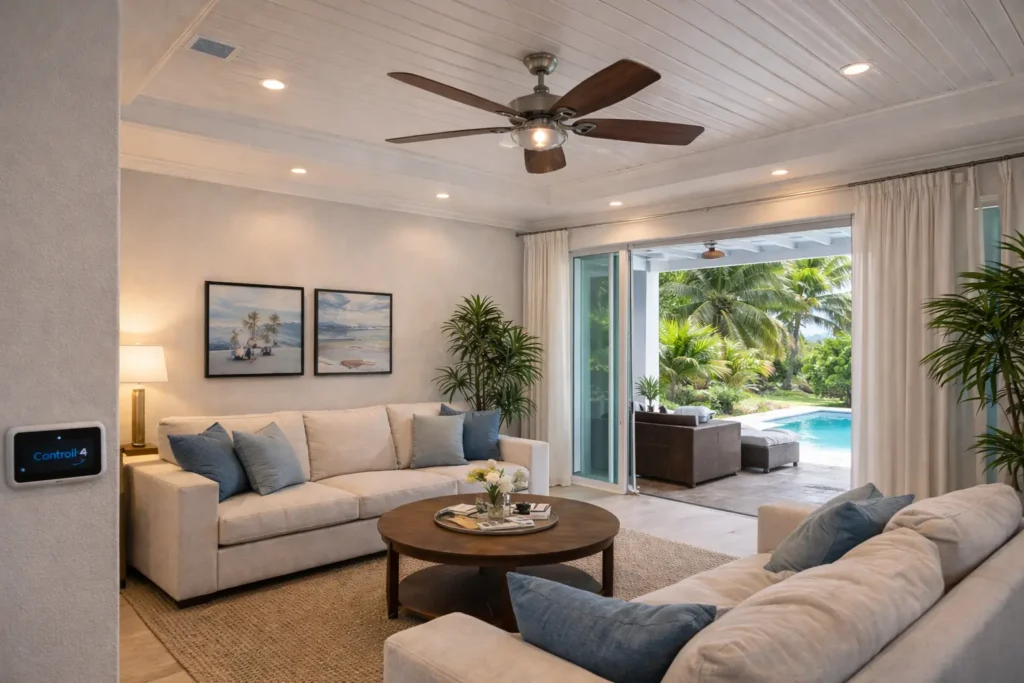
Integration Note: Systems like Lutron RadioRA 3 and Somfy TaHoma connect directly with Control4, Josh.ai, and Apple HomeKit — meaning your motorized shades in Tampa can be choreographed with every other smart system in the home. This is whole-home automation, not a gadget.
The Best Fabric Choices for West-Facing Windows in Florida
Fabric selection is where most homeowners get tripped up — and where most DIY online orders go wrong. The right fabric for a west-facing Tampa window balances three competing demands: heat blockage, outward visibility, and interior light quality. Here’s a full breakdown of the options and what each one actually does.
Solar / Screen Fabrics — The Florida Standard
Solar shades are the most common — and most effective — choice for west-facing windows in Tampa Bay. They’re open-weave fabrics that block solar radiation while preserving some degree of outward visibility. The key specification is openness factor: the percentage of the weave that is open (allowing light through) versus closed (blocking heat and UV).
| Openness Factor | Heat / UV Block | Outward View | Best Use — Tampa |
| 1% — Best for West-Facing | ~99% UV block, maximum heat reduction | Minimal — slightly hazy outward view | West/SW-facing living rooms & bedrooms — maximum heat control with daytime privacy |
| 3% openness | ~97% UV block, strong heat reduction | Moderate — yard and pool still visible | West-facing great rooms, dining areas — sun managed, view preserved |
| 5% openness | ~95% UV block, good heat reduction | Good — relatively clear view | West-facing home offices; windows with partial shading from trees or overhangs |
| 10% openness | ~90% UV block, moderate reduction | Excellent — near-transparent | East/north-facing windows, or west windows with significant exterior shading already |
For most west-facing rooms in Tampa homes without exterior overhangs, 1% to 3% openness is the right call. The view-vs-privacy tradeoff is well worth it when the alternative is a room that becomes uninhabitable from 3–7 PM every day.
Blackout Fabrics — When Full Block Is the Answer
Blackout fabrics block all light and essentially all direct solar heat. They’re the right choice for west-facing bedrooms where afternoon napping matters, media rooms where screen glare is an issue, and any space where complete light control is the priority. The tradeoff: zero outward visibility and a significantly heavier feel to the room when closed.
In Tampa Bay homes, we frequently see layered systems on west-facing windows: a 1–3% solar shade that handles the majority of afternoon hours, paired with a blackout shade for nighttime privacy or media use. Both run on the same motorized track — controlled independently or together from a single scene. You can see how this plays out in a real Tampa home in our post on how smart shades changed the way one Tampa family lives.
Light-Filtering Fabrics — What They Don’t Do Well Here
Light-filtering fabrics — the soft, semi-translucent wovens that diffuse light without blocking it — are popular in general interior design but are largely misapplied on west-facing Florida windows. They soften glare visually but do very little to block heat. If your priority is managing Tampa’s afternoon sun, light-filtering fabric on a west-facing window is essentially decorative. It looks good; it doesn’t perform where it matters.
Hive’s Fabric Recommendation by Room Type: West-facing living room → 3% solar | West-facing master bedroom → 1% solar + blackout layered system | Home office → 3–5% solar | Media/theater room → Blackout only | Kitchen → 3% solar (durable, easy-clean options available)
Motorized Shade Brands Worth Choosing in Tampa Bay
Not all motorized shade systems are equal — and in Florida’s climate, the motor, fabric quality, and control ecosystem matter enormously. At Hive, we install and specify from a small set of proven brands that have earned their place in Tampa Bay luxury and mid-range installs alike.
- Lutron Palladiom / Sivoia QS: Industry gold standard for precision, whisper-quiet operation, and deep integration with Lutron RadioRA 3 and whole-home lighting systems. The choice for high-end Tampa homes with Control4 or Crestron backbones.
- Somfy RTS / OREA: Excellent retrofit option for existing homes — strong wireless performance, broad fabric library, and reliable TaHoma connect hub for app and voice control. A Hive favorite for Tampa homes mid-renovation.
- Lutron Roller Shades (Triathlon fabrics): Lutron’s own fabric line includes performance solar fabrics tested specifically for solar heat gain reduction. Pairs seamlessly with any Lutron ecosystem already in the home.
- QMotion / Legrand: Battery-powered wireless option for spaces where hardwiring isn’t practical. Good performance in lighter-load applications — not our first recommendation for large west-facing spans in Tampa heat.
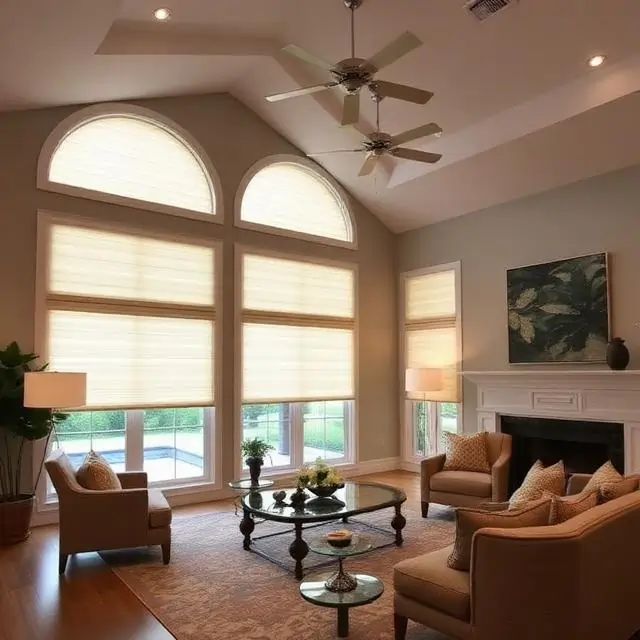
The motor type matters in Florida specifically because of humidity and temperature cycling. Cheap motors — and many online-direct brands — use lubricants and internal components that degrade faster in humid subtropical climates. After a few Florida summers, they slow, drift, or stop aligning correctly. Lutron and Somfy motors are rated for harsh environments and carry multi-year warranties that actually hold up.
Hive designs and installs motorized shading systems throughout Tampa Bay — from single-room upgrades on problem west-facing windows to full whole-home shade automation integrated with your Control4 or Lutron lighting system. We handle fabric specification, motor selection, programming, and licensing. Book a free consultation and we’ll assess your windows and recommend the right solution.
Smart Scheduling: How Tampa Homeowners Automate Shade Control
The most common question we hear from Tampa homeowners considering motorized shades: “Do I really have to program all of this myself?” The answer — when Hive installs and programs the system — is no. You won’t manage schedules manually. The system learns your home’s solar pattern and runs automatically.
This is especially relevant during summer — and if you haven’t thought through your home’s full seasonal readiness, our guide on smart home summer prep for Tampa is worth reading alongside this one. Here’s how a well-designed motorized shade schedule works for a typical Tampa Bay home with west-facing exposure:
- 6:30 AM — Morning rise: All shades open as the household wakes. East-facing rooms catch natural morning light. West-facing shades stay open — morning sun from the east is mild and beneficial.
- 1:00–1:30 PM — West shades close: Triggered by time schedule or solar sensor, west-facing motorized shades lower automatically — before you ever feel the heat building.
- Afternoon — Hold position: Shades remain down, intercepting direct solar radiation through peak heat hours. AC load drops measurably.
- Sunset — West shades rise: As the sun drops below the horizon, shades rise automatically. Evening views of Tampa Bay sunsets — unobstructed.
- Bedtime scene: Master bedroom blackout shades close. Living room solar shades close for privacy. One tap or voice command.
For Tampa homes on Control4 or Josh.ai, shade schedules adjust automatically based on astronomical clock data — meaning the system knows the exact solar position for your address on any day of the year and adapts accordingly. No summer vs. winter reprogramming. No manual override on cloudy days unless you want one.
West-Facing Window Challenges Hive Solves Across Tampa Bay
Tampa Bay’s architecture creates a particular west-facing exposure problem we see repeatedly across specific neighborhoods.
In Davis Islands and Harbour Island, waterfront homes are frequently oriented to capture water views — and those views face west and southwest. The same windows that frame Tampa Bay sunsets bake the interior for four to five hours every afternoon. We’ve retrofitted dozens of these homes with layered Lutron solar and blackout systems, bringing afternoon room temperatures down dramatically without sacrificing the view. Davis Islands is one of several Tampa neighborhoods where smart upgrades like these have become the norm — see our breakdown of 5 Tampa neighborhoods going all-in on smart home upgrades for the full picture.
In Carrollwood and New Tampa, where newer construction features open-plan great rooms with large spans of west-facing glass, single-window coverage rarely solves the problem. We design multi-drop systems that treat an entire west-facing wall as a single automated zone — six or eight shades dropping simultaneously into perfect alignment from one schedule or one voice command.
In Hyde Park and South Tampa, where older Craftsman and Mediterranean homes have original single-pane west windows, shade performance matters even more — there’s no insulated glass unit doing partial work. We spec 1% solar fabrics in these situations and often recommend motorized exterior solar screens where the architecture allows.
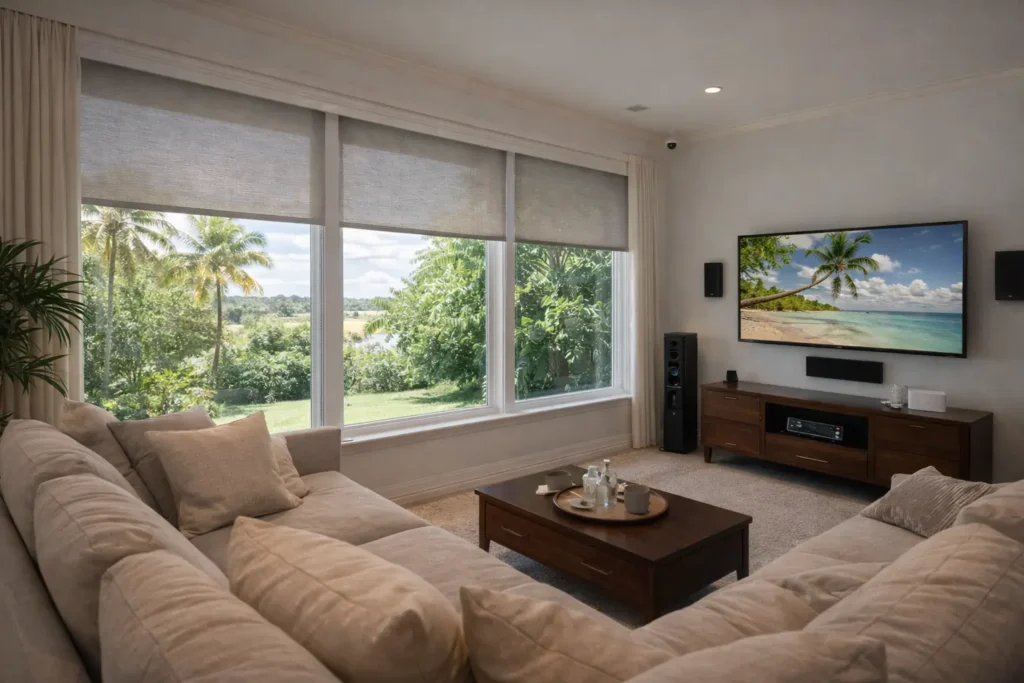
Florida building code and HOA considerations also matter. Some Tampa Bay HOAs restrict visible exterior modifications — motorized interior solar shades sidestep those restrictions entirely while still delivering significant performance. Hive pulls all required low-voltage permits under our Florida ES license and coordinates with your HOA documentation if needed. If you’re curious about what permitting looks like for this type of project, our post on low-voltage permits and smart home installations in Tampa covers it in depth.
West-facing windows in Tampa aren’t going to shade themselves. Every afternoon, unshaded west glass is working against your comfort, your energy bill, and your furniture — and the fix doesn’t have to be complicated. The right motorized shade fabric, sized correctly, mounted properly, and programmed to move automatically, turns your worst sun exposure into a non-issue. You keep the view. You keep the natural light in the morning. And you stop paying to cool a room that your windows are actively heating every afternoon.
Motorized shades Tampa homeowners choose through Hive aren’t an off-the-shelf product — they’re a system designed around your home’s specific orientation, window dimensions, lifestyle, and smart home ecosystem. From fabric specification to final programming, we handle everything under one licensed, local team.
Ready to fix your west-facing windows? Hive serves Hillsborough, Pinellas, and Pasco counties. Start with a free, no-obligation consultation — we’ll assess your sun exposure, recommend the right fabric and motor combination, and give you a clear scope before any commitment.
FAQs
Q1: What is the best shade fabric for west-facing windows in Florida?
A: For west-facing windows in Florida, a 1% to 3% openness solar fabric is typically the best choice. The tighter the weave, the more solar heat and UV radiation it blocks — critical for the intense afternoon sun that hits west-facing glass in Tampa Bay. Lutron and Somfy both offer high-performance solar fabrics rated for Florida’s climate and humidity.
Q2: How much do motorized shades cost in Tampa Bay?
A: Motorized shade costs in Tampa Bay vary based on window count, fabric selection, motor type, and smart home integration. A professionally installed Lutron or Somfy system typically starts around $800–$1,200 per window opening for a quality solar fabric with motorization. Hive provides detailed quotes after a free in-home consultation — no guesswork pricing.
Q3: Do motorized shades actually reduce heat gain through windows?
A: Yes — significantly. A 1% openness solar fabric can block up to 99% of UV radiation and reduce solar heat gain through west-facing glass by 65–80% depending on installation quality and light gap control. The key is positioning the shade close to the glass to intercept solar radiation before it heats the room’s air mass.
Q4: Can motorized shades be scheduled to open and close automatically in Tampa?
A: Absolutely. Hive programs shades to close automatically in the early afternoon when west-facing solar gain peaks, and to rise again at sunset — using time schedules, astronomical clock data, or solar sensors. The system runs daily without any manual input required.
Q5: What’s the difference between solar shades and blackout shades for Florida homes?
A: Solar shades use an open-weave fabric that blocks UV and heat while preserving outward visibility — ideal for west-facing living spaces in Tampa where you want sun control without losing the view. Blackout shades block all light and maximum heat, making them the right choice for bedrooms, media rooms, or anywhere full light control is the priority. Many Tampa homes layer both on the same window track for maximum flexibility.
Q6: Does Hive install motorized shades throughout Tampa Bay?
A: Yes. Hive installs motorized shading systems across Hillsborough, Pinellas, and Pasco counties — including Davis Islands, South Tampa, Hyde Park, Carrollwood, Westchase, and New Tampa. We’re a licensed Florida low-voltage contractor (ES License) and handle everything from fabric specification to final programming and permitting.
Q7: Can I add motorized shades to my existing Control4 or Lutron smart home system?
A: Yes — this is one of the most common projects Hive handles. Lutron motorized shades integrate natively with Lutron RadioRA and Caseta ecosystems, and both Lutron and Somfy shade systems connect seamlessly with Control4, Josh.ai, and Apple HomeKit. Your new shades can be programmed into existing scenes without replacing any existing hardware.